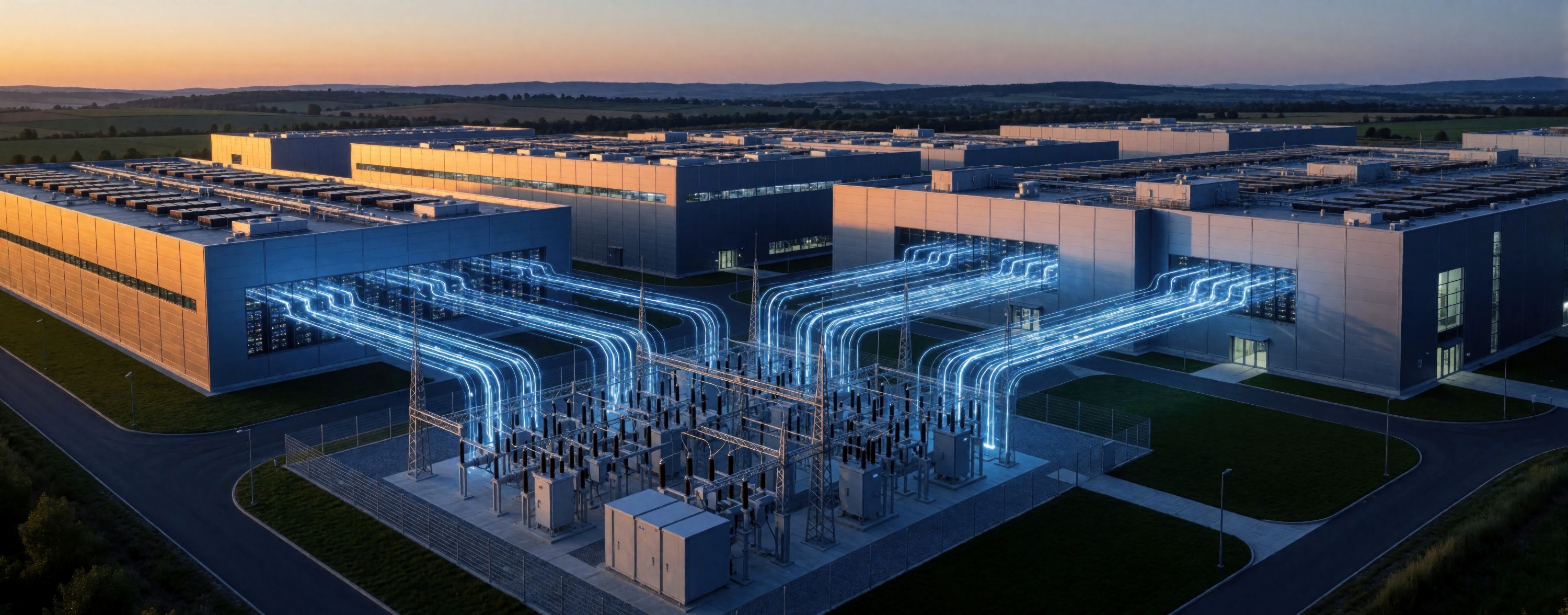
AI data center power is becoming a critical constraint on AI infrastructure as increasing compute density requires more electricity to be delivered, converted and cooled within finite electrical, thermal and physical limits. As rack power rises, higher-voltage DC distribution, more efficient power conversion, faster protection and system-level power architectures will become increasingly important for scaling AI infrastructure efficiently and reliably.
How Much Power Do AI Data Centers Require?
Large AI model deployments and increased use of AI applications are resulting in unprecedented increases in power density. The scale of this challenge is apparent. Data center energy demand could more than double by 2030. As electricity consumption grows, so does the importance of efficient AI power infrastructure.
Why Is Power Delivery Becoming a Bottleneck for AI Data Centers?
Increasing computing capacity requires more than supplying additional electricity to a data center. Power must travel through multiple conversion and distribution stages before reaching the processors doing the computational work.
In today’s systems, electricity enters the facility at high voltage, then is converted, distributed and stepped down multiple times before reaching the low voltages required by GPUs and other accelerators. Every stage introduces some loss, and that lost energy becomes heat that must ultimately be removed from the system.
At lower power levels, those losses are relatively manageable. At AI scale, they become much more consequential. Even small inefficiencies can translate into significant energy waste and additional cooling requirements as power density increases.
This changes the role of power architecture in the data center. Efficiency is no longer simply an operating-cost consideration. It influences how much computing capacity can be deployed within available electrical, thermal and physical constraints.
Why Are AI Data Centers Moving to Higher-Voltage Power Distribution?
As AI rack power increases, moving large amounts of power at relatively low voltages becomes more difficult. For a given amount of power, lower-voltage distribution requires higher current, which increases resistive losses, conductor requirements and dissipated heat.
For this reason, the industry is pursuing higher-voltage DC distribution. Architectures based around higher DC bus voltages reduce current for similar and increased power levels, helping reduce distribution losses and the amount of copper required to move power through the system.
Emerging architectures based around hundreds of volts of DC, including 800 V systems, represent a significant departure from traditional server power distribution. But increasing distribution voltage is only part of the solution. It also changes the requirements for power conversion, control, protection and cooling throughout the data center.
What Do Higher-Voltage Architectures Mean for Power Electronics?
Higher-voltage distribution creates new opportunities for efficiency, but it also places greater demands on the power electronics responsible for converting and controlling energy throughout the system.
Ultimately, power must move from hundreds of volts at the distribution level to the very low voltages required by advanced processors. Each conversion stage has to accomplish this while minimizing energy losses, managing heat and fitting within increasingly constrained physical environments.
Wide-bandgap materials such as silicon carbide (SiC) and gallium nitride (GaN) offer characteristics that can improve efficiency and power density in appropriate stages of the power architecture. Their ability to operate efficiently at higher voltages and switching frequencies can reduce conversion losses while allowing power systems to become smaller and more power dense.
Circuit protection is evolving alongside power conversion. Unlike AC systems, where current naturally passes through zero during each cycle, DC systems present different challenges when faults occur. As higher-voltage DC distribution becomes more prevalent, faster approaches to detecting and isolating faults will become even more crucial. In particular, solid-state protection can limit fault energy and prevent localized failures from affecting larger portions of the power system.
At the same time, improvements in individual power devices will not be enough on their own. Electrical, mechanical and thermal design decisions are closely connected, making system-level optimization essential as AI infrastructure moves to higher power levels.
Why AI Data Center Efficiency Is a System-Level Challenge
Historically, improvements in individual components delivered meaningful efficiency gains. As AI systems move toward substantially higher power densities, however, optimizing one component or conversion stage in isolation becomes less effective.
The objective is not simply to make each conversion stage more efficient, but to reduce losses across the system while continuing to increase the amount of computing capability that can be supported within a given power and thermal envelope. This system-level approach will become increasingly important as data center operators balance competing demands for greater computing performance, electrical capacity, reliability and energy efficiency.
Power Will Help Define How Far AI Can Scale
The future of AI will be shaped as much by power delivery as by computing performance. As training clusters grow and inference becomes embedded across more applications, increasing compute capacity will depend on the industry's ability to deliver more power within finite electrical, thermal and physical limits.
Meeting that challenge will require more than adding generation or facility capacity. It will require innovation in how energy moves from the grid to the core. Higher-voltage distribution, more efficient conversion, faster protection, improved thermal management and greater integration will all have roles to play. As AI pushes infrastructure to new limits, power architecture will become as fundamental to scaling AI as the processors themselves.
FAQs
Why do AI data centers require so much power?
AI accelerators such as GPUs operate at very high compute densities, increasing both electrical demand and the amount of heat that the infrastructure must remove.
Why are AI data centers moving to higher DC voltages?
Higher distribution voltages reduce the current required to deliver a given amount of power, which can reduce resistive losses, conductor requirements and heat.
What is 800 VDC in AI data centers?
800 VDC is an emerging higher-voltage power distribution architecture designed to support increasing AI rack power while reducing the challenges associated with distributing very high currents.
What role does SiC play in AI data centers?
SiC devices can improve efficiency in high-voltage power conversion, helping reduce power losses and support greater power density. These characteristics make SiC well suited for appropriate stages of next-generation AI data center power architectures.
What role does GaN play in AI data centers?
GaN devices can improve power conversion efficiency and power density by operating efficiently at high switching frequencies. These characteristics can help reduce conversion losses and enable smaller power systems at appropriate stages of AI data center power architectures.
Why is solid-state protection important in AI data centers?
DC faults behave differently from AC faults because DC current does not naturally cross zero. Faster solid-state protection can therefore help limit fault energy and isolate failures in higher-voltage DC systems.