Solid-State Transformers Gain Traction as AI Data Centers Push Shift to High-Voltage DC
Key Takeaways
- The market for Solid-State Transformers (SSTs) is entering an early commercialization phase, driven by growing power demands from artificial intelligence data centers, electric-vehicle charging networks and grid modernization projects.
- Industry momentum has accelerated as hyperscale data center operators and infrastructure providers increasingly evaluate 800-volt high-voltage direct current (HVDC) architectures as a replacement for conventional 12V and 48V power distribution systems beginning later this decade.
- SSTs are increasingly viewed as a foundational technology for this transition because they enable direct conversion from medium-voltage alternating current (AC) to low-voltage direct current (DC), reducing conversion stages and improving overall system efficiency.
Addressing the Power Challenge in AI Infrastructure
The rapid growth of artificial intelligence is placing surging demands on data center power infrastructure. Traditional power distribution systems, built around 400V AC buses and multiple conversion stages down to low-voltage server supplies, are increasingly strained.
To address these challenges, the industry is transitioning toward 800V HVDC architectures. NVIDIA has announced a transition to 800V HVDC starting in 2027, replacing traditional 12V/48V systems. This approach enables direct conversion from 13.8kV AC to 800V DC, significantly reducing the number of conversion stages.
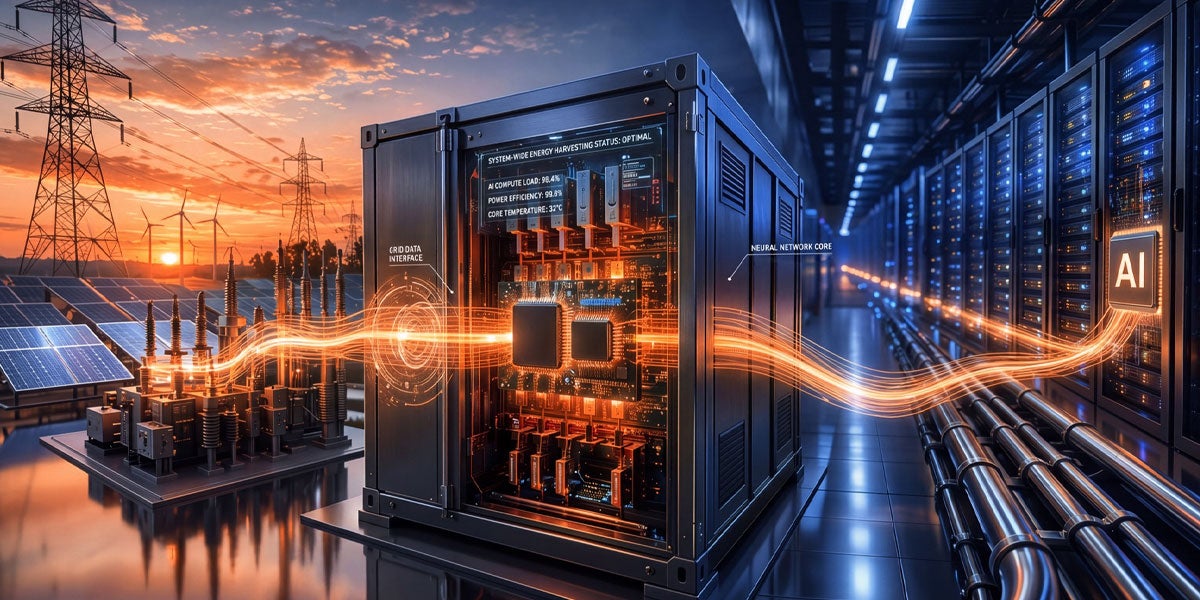
Solid State Transformers (SSTs) are emerging as a critical technology in this shift. They replace traditional transformers and enable direct high-voltage power conversion, delivering more efficient, flexible, and scalable power delivery for next-generation AI facilities.
Why Power Semiconductors are Essential to SST Success
The rise of SSTs is creating demand for a new generation of high-voltage silicon carbide devices. SST architectures commonly employ cascaded H-bridge topologies. Front-end AC-DC stages typically require SiC devices rated between 2,300 V to 6,500 V, while downstream DC-DC stages generally utilize devices rated between 1,200 V to 2,300 V
As system voltages increase, attention is shifting toward 10 kV-class SiC MOSFETs. These devices offer substantially lower switching losses than traditional insulated-gate bipolar transistor (IGBT) modules while enabling simpler system architectures.
Compared with conventional multilevel SiC or IGBT-based designs, 10 kV SiC devices can reduce component counts, improve efficiency and simplify thermal management—advantages that are particularly important in high-power SST systems.
High-voltage devices also require advanced gate-driver technologies capable of delivering high isolation voltage and robust performance under extreme dv/dt conditions. Functional operating voltage of 3.0KV needed for 2.0KV Bus Voltage.
Where onsemi Technologies Fit in SSTs
As solid-state transformers move toward commercialization, onsemi is positioning itself as a provider of the high-voltage silicon carbide technologies required to enable more efficient, scalable and cost-effective power conversion. The company's portfolio spans commercial SiC power modules, next-generation high-voltage devices and advanced power protection technologies that address emerging demand from AI data centers, grid modernization projects, industrial power systems and electrification infrastructure.
Key offerings include:
- Commercial SiC power modules that support high-efficiency power conversion in today's solid-state transformer designs and other high-power infrastructure applications.
- Next-generation 2.3kV and 3.3kV SiC technologies that are being developed to help customers build higher-voltage, higher-power SST systems with fewer components and improved efficiency.
- Cost-optimized power solutions that combine silicon carbide and silicon technologies to deliver near-SiC performance while lowering system costs.
- Building-block architectures that can be scaled from hundreds of kilowatts to multiple megawatts, supporting applications ranging from industrial power systems to grid infrastructure and AI data centers.
- Advanced SiC technologies designed to operate in demanding environments, including aerospace, satellite and other mission-critical applications.
- SiC-based power protection solutions that can be used in solid-state circuit breakers, power bypass systems and other critical infrastructure designed to improve reliability and resilience.
Solid-State Transformers (SSTs) represent a key advancement in addressing the surging power demands of next-generation AI facilities. By reducing conversion stages and improving overall system efficiency, SSTs help overcome the limitations of traditional transformer-based systems. As adoption increases, demand for high-voltage silicon carbide (SiC) devices are expected to grow, positioning onsemi to support the development and deployment of these next-generation power systems with the efficiency, reliability, and resilience required for the AI era.