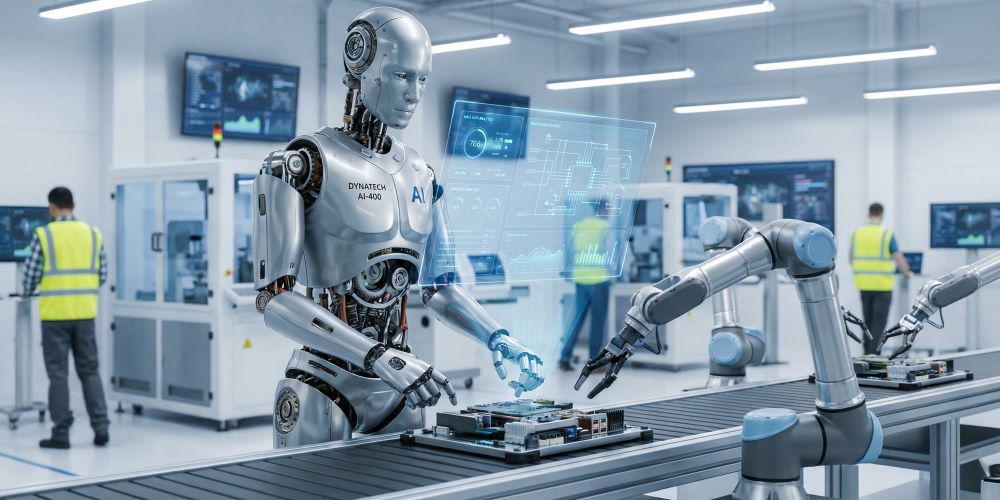
Humanoid robot working on a machine

Transforming Work Through Intelligent Automation

Humanoid robots combine artificial intelligence, advanced sensing, autonomous mobility, and human-like dexterity to perform tasks in complex real-world environments. These systems have the potential to address labor shortages, improve productivity, enhance safety, and transform industries ranging from manufacturing and logistics to healthcare and service automation.

Enable Physical AI with Humanoid Robotics

Humanoid robotics combines AI and semiconductor technology to enable real-time perception, decision-making, communication, and motion control in human environments. Unlike industrial robots, humanoids navigate dynamic spaces, interact safely with people, manipulate varied objects, and adapt to changes. This requires advanced electronics, software, and semiconductor solutions. Modern humanoids rely on five key subsystems: compute, sensing & perception, actuation, power, and connectivity, enabling autonomous perception, decision-making, and task execution.

The compute subsystem acts as the robot's brain, enabling AI, machine learning, motion planning, and sensor fusion. It processes data from cameras, depth sensors, inertial sensors, and more using high-performance processors and neural units. AI inference at the edge allows real-time decision-making without cloud reliance. The sensing & perception subsystem provides environmental awareness through image sensors, depth technologies, radar, tactile sensors, and audio inputs. Combining these modalities helps robots detect obstacles, identify objects, estimate distances, and navigate complex environments.

The actuation subsystem converts digital commands into physical movement. Humanoid robots use numerous independently controlled joints across their body, each needing motor-control electronics. These systems use microcontrollers, gate drivers, power semiconductors, sensors, and feedback devices for precise motion. Advanced robotic hands add complexity with tactile and force sensors for tool manipulation. The power subsystem supports these functions with battery management, power distribution, voltage conversion, and charging infrastructure. Efficient technologies like silicon MOSFETs, GaN, and SiC devices enhance energy efficiency, reduce weight, and extend operating time.

The fifth building block, connectivity, enables communication within the robot and with external systems. High-speed networks facilitate data exchange between sensors, actuators, control units, and infrastructure like fleet-management platforms. Key trends include Physical AI, sensor fusion, dexterous manipulation, distributed computing, and energy-efficient actuators. The main challenge is ensuring reliable, safe operation in unstructured environments where robots must perceive, reason, and act in real time. Adherence to standards like ISO 10218, ISO/TS 15066, IEC 61508, ISO 13849 and IEC 60204-1 ensures safety, reliability, cybersecurity, and regulatory compliance as robots scale from pilots to commercial use.
Block Diagrams

製品

Image Sensors
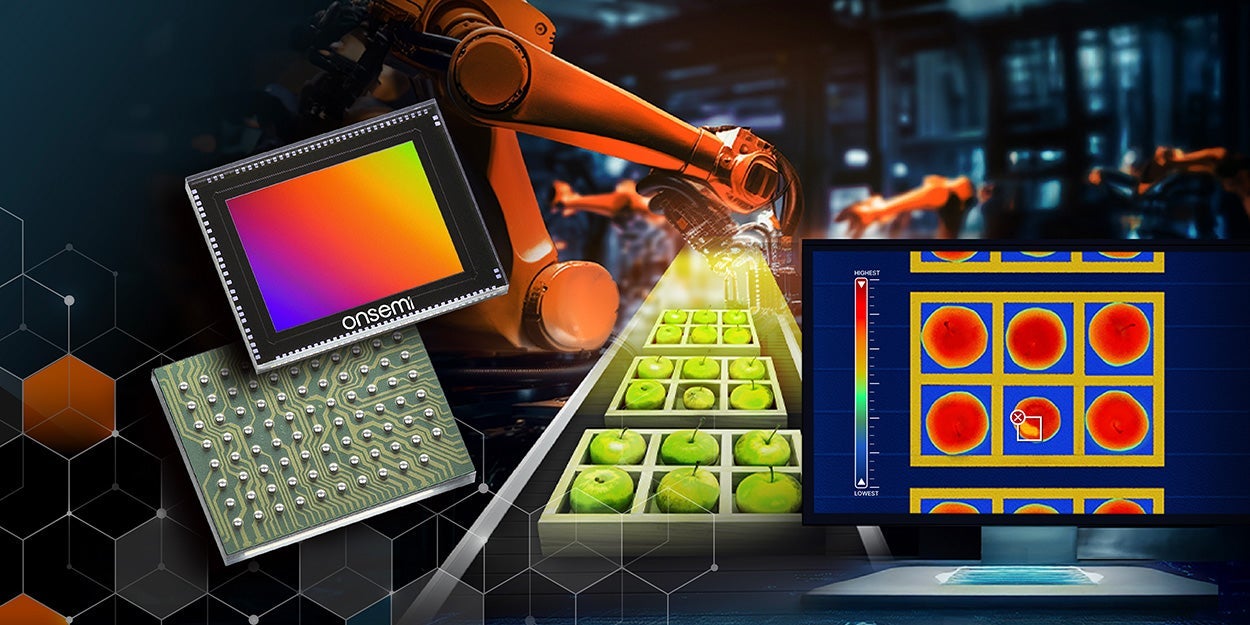
A broad portfolio of industry leading image sensors that satisfy requirements of every possible end application from wearables and consumer electronics to demanding industrial and automotive applications.
Image Signal Processors (ISPs)
A selection of imaging co-processors for use with advanced CMOS image sensors.
Low/Medium Voltage GaN FETs
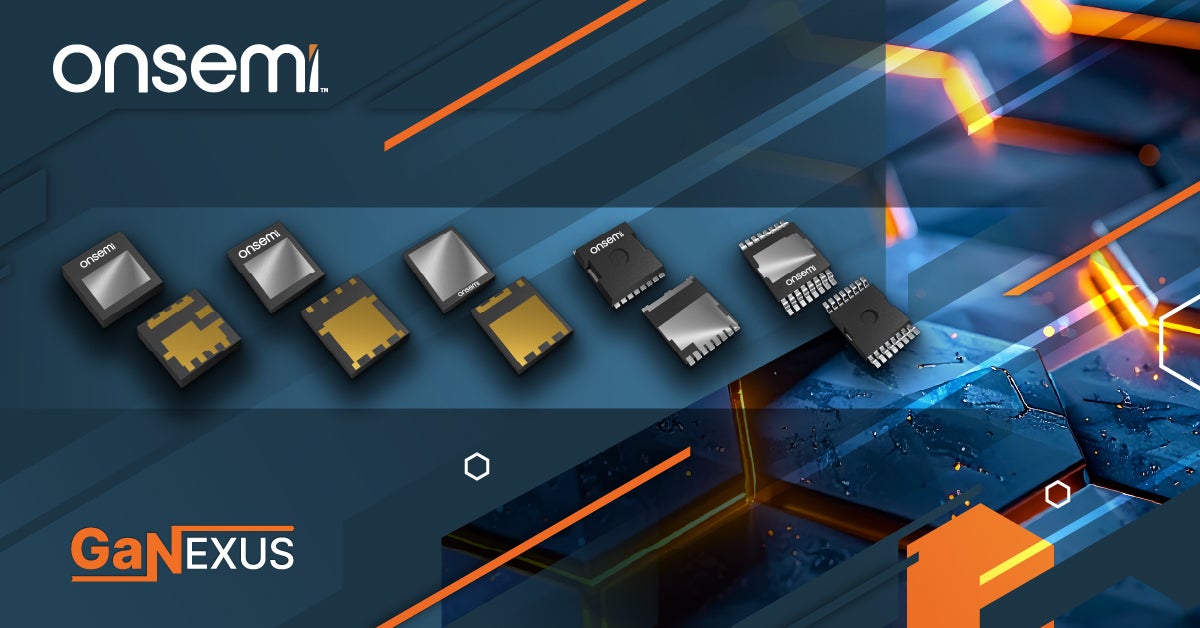
GaNEXUSTM Enhancement-mode discrete lateral GaN HEMTs 40V – 200V, optimized for high-efficiency, mid-voltage power conversion and compact system designs.
Low/Medium Voltage MOSFETs
Portfolio of comprehensive range of Low-medium voltage power Mosfets that delivers superior performance and reliability for switching applications. Our cutting-edge PowerTrench® T10 technology delivers industry leading RDS, higher power density, reduced switching losses and better thermal performance.
Motor Drivers
A selection of brushed, brushless, stepper motor drivers and controllers along with some load and relay drivers.
Ethernet Controllers
IEEE-compliant ethernet controllers designed for robust communication in a wide range of environments and applications.
Silicon Photomultipliers (SiPM)
onsemi offers a complete line of Silicon Photomultipliers (SiPM) covering a wide range of applications.
Bluetooth Low Energy
RSL15
Bluetooth® 5.2 Secure Wireless MCU
Inductive Sensing
NCS32100
Industrial Rotary Position Sensor
Ultrasonic Sensor
NCV75215DB001R2G
Ultrasonic Parking Distance Measurement ASSP
Sensor Signal Conditioning
NCV7192
Bridge Signal Conditioning Interface with Analog or SENT output
Sensor Signal Conditioning
NCV76124
Rain and Light Sensor Interface with SPI

Documents

Tutorial
GaN Power Architectures Guide
Tutorial
Image Sensors for Drones and Robotics Tutorial
White Papers
Exploring the Impact of Image Sensors in Robotics and Automation
Application Notes
Top Cool Package for Power Discrete MOSFETs
White Papers
From Scanning to Seeing: How Hyperlux™ ID Empowers the Next Generation of Machine Vision
Tutorial
Streamlining Designto- Manufacture for Imaging Devices Tutorial
Tutorial
Enabling Smarter industrial 3D Sensing with Hyperlux ID
White Papers
Cutting-Edge Global Shutter Image Sensors for High-Speed Applications
White Papers
Introducing onsemi's Premier Reference Image Sensor Module (PRISM) Designed to Optimize Camera Development
White Papers
Laser Imaging Using Short Wave Infrared (SWIR) Image Sensors
White Papers
Overcoming Challenges through Indirect Time‐of‐Flight Advancements
White Papers
High-Reliability Signal Conditioning for Pressure and Force Sensors

Evaluation Boards/Kits

Evaluation Kit
NCV7192EVK
Bridge Signal Conditioning Interface Evaluation Kit
Evaluation Kit
NCV75215R1GEVK
Ultrasonic Sensor Evaluation Kit
Evaluation Kit
AGB1N0CS-GEVK
Demo 3 Baseboard
Evaluation Board
AF0130CSSM30SMKAH3-GEVK
Indirect Time of Flight (iToF) Depth Sensing Evaluation Board
MODULE
PRISM1M-AR0235CSSM130110-GEVB
The AR0235CS 2.0 MP Premier Reference Image Sensor Module (PRISM) module
MODULE
PRISM1M-AR0145CSSM130110-GEVB
AR0145CS 1.0 MP Premier Reference Image Sensor Module (PRISM) module
Evaluation Kit
NCV76124EVK
Rain and Light Sensor Evaluation Kit
Evaluation Kit
NCV705XXLITEGEVK
NCV705XX Microstepping motor driver family evaluation kit
Evaluation Kit
LV8907UWGEVK
Sensor-less Three-phase Brushless DC Motor Controller, with Gate Drivers Evaluation Kit
Evaluation Board
LV8968BBGEVB
Multipurpose Three-Phase Brushless DC Predriver Evaluation Board

Design Resources

Tools and resources for your evaluation process.

Find the Right Product

Utilize our PRT+ tool to identify the ideal product for you.

System Solution Guides

Explore tailored components and insights for your application.

Evaluation Boards & Kits

Buy and validate the performance of chosen components.

FAQs

Modern humanoid robots are typically organized into five major subsystems: Actuation, Sensing & Perception, Power, Compute, and Connectivity. These blocks work together to enable human-like movement, environmental awareness, decision-making, and communication. Enterprise robotics architecture references also highlight distributed intelligence, where local controllers, sensors, and motor drives operate alongside centralized AI compute.

Key challenges include achieving human-like dexterity, balancing compute performance with battery life, ensuring functional safety around people, managing thermal dissipation, integrating sensors and actuators and lack of training data. Real-time coordination between perception, decision-making, and motion control remains one of the most difficult engineering problems.

Gallium Nitride (GaN) devices offer higher switching frequencies, lower losses, greater power density, and smaller system size compared to conventional silicon MOSFET solutions. These advantages help reduce actuator size and weight while extending battery operating time—both essential requirements for mobile humanoid platforms.

The industry is moving from a single centralized controller toward distributed intelligence architectures. High-performance AI processors handle perception and planning while localized controllers manage motion, sensing, and safety functions. This approach reduces latency, improves scalability, and enables faster real-time responses.

Humanoid robots rely on a fusion of multiple sensing technologies, including:

  • RGB and global shutter cameras
  • Time-of-Flight (ToF) depth sensors
  • IMUs and position encoders
  • Force and torque sensors
  • Tactile and pressure sensors
  • Microphone arrays
  • Radar and proximity sensors

Sensor fusion enables the robot to perceive, understand, and safely navigate complex environments.

Related Videos

Let's keep going – watch these videos for deeper dives and fresh perspectives.

Support and Community

If you're interested to learn about any onsemi technology, search for related articles in Help library.

サポート

オンセミは、お客様の利便性を考慮し、さまざまな方法によるお問い合わせに対応しています。

セールス

製品に関するご質問、またはデザインに関するサポートが必要ですか?

更新情報

新製品リリース、イベント、技術的洞察!

humanoid robotics